
Choosing a Compost Bin: Heaps, Bays, Tumblers, Worms and Bokashi
Open heap, slatted bays, plastic cone bin, tumbler, worm bin or bokashi bucket? What each compost system is good at, its drawbacks, and how to pick one for your space.
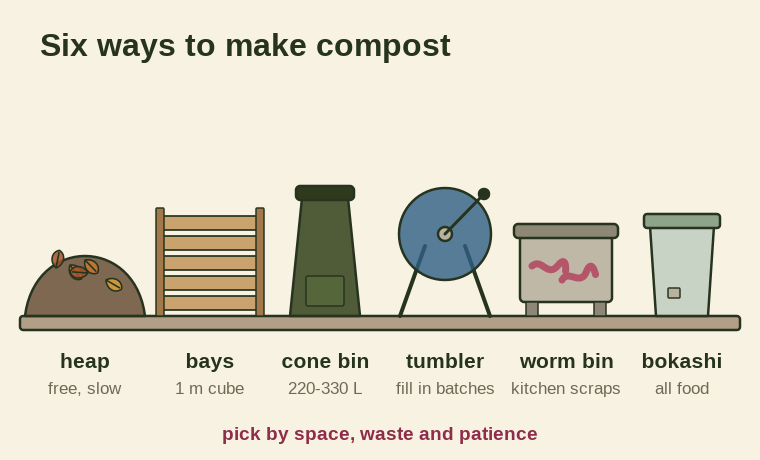
On this page
Every compost system does the same basic job: it gives microbes, fungi and small creatures a place to turn scraps and garden waste into a dark, crumbly soil improver. What changes from one bin to the next is how much space it needs, how much work it takes, how fast it goes and which waste it can handle.
There is no single best bin. A slatted bay that suits a big vegetable garden is useless on a fourth-floor balcony, and a worm bin cannot swallow a summer of lawn clippings. This guide compares the main options so you can match one to your space, waste and patience.
Start with three questions
Before looking at bins, answer these:
- What will you compost? Mostly kitchen scraps, mostly garden waste, or a mix? Cooked food and meat rule out most open systems.
- How much space and soil do you have? Bins that sit on bare soil let worms and moisture move in and out. Balconies and patios need a closed system.
- How much work will you really do? Weekly turning is faster, but an ignored bin still works, just slowly.
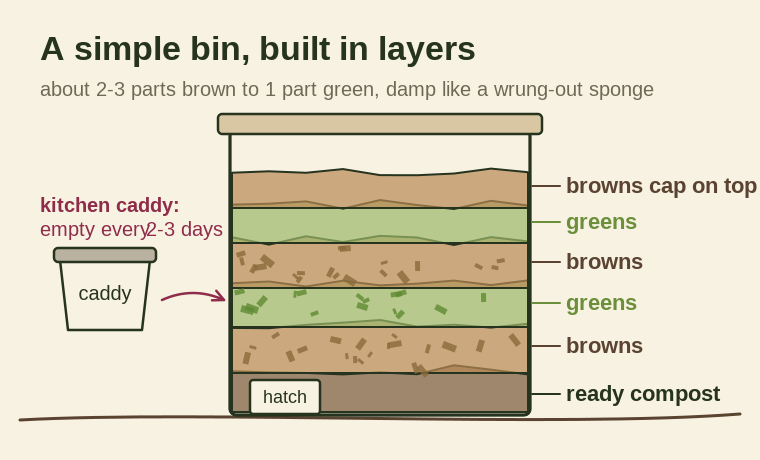
If you are new to the process itself, our guide to starting composting at home covers the basics of greens, browns and moisture.
The options at a glance
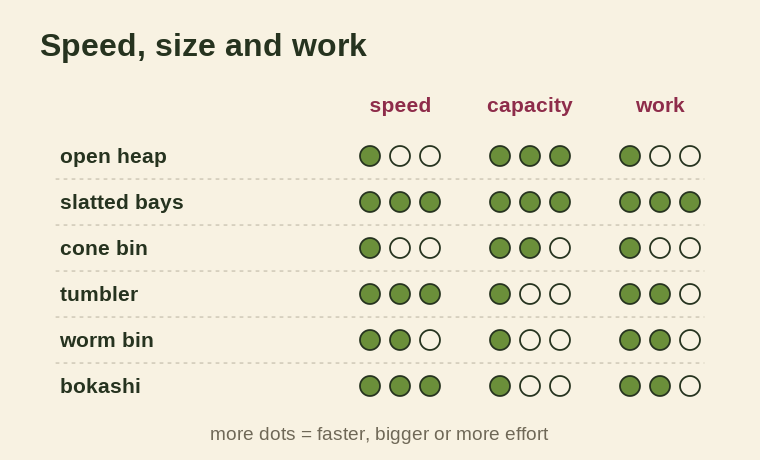
| System | Typical size | Time to compost | Takes cooked food? | Best for | Main drawbacks |
|---|---|---|---|---|---|
| Open heap | Any | 6 to 18 months | No | Large gardens, lots of leaves | Untidy, can dry out |
| Slatted bays | About 1 m cube each | 2 to 12 months | No | Keen gardeners, hot composting | Needs space and timber |
| Plastic cone bin | 220 to 330 liters | 6 to 12 months | No | Small and medium gardens | Slow, awkward to empty |
| Tumbler | 100 to 250 liters | 2 to 6 months | No | Patios, people who dislike forking | Small capacity, can go soggy |
| Worm bin | 40 to 100 liters | 3 to 6 months | Small amounts | Kitchens, balconies | Worms need care and steady temps |
| Bokashi bucket | 15 to 20 liters | 2 weeks plus 2 to 4 weeks in soil | Yes, including meat | Flats, all food waste | Needs bran, output is not finished compost |
Times are rough and depend on the mix, the season and how often it is turned.
Open heap
The oldest system is a pile in a corner. It costs nothing and holds as much as you like, but it loses heat and moisture from its sides, so it is usually slow and cool. A heap suits autumn leaves, prunings and seed-free weeds. Cover it with an old tarp or flattened cardboard to keep rain off and warmth in.
Slatted wooden bays
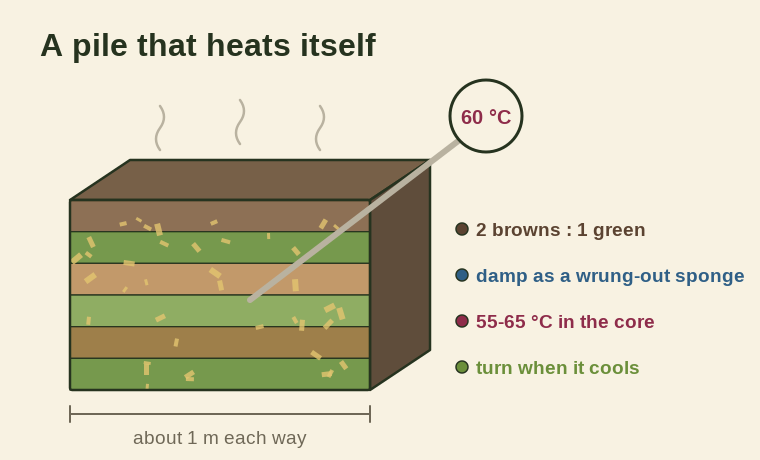
Two or three bays side by side, each about 1 meter wide, deep and high, are the classic setup for a big garden. One bay fills, one matures, and you fork material from one to the next, which turns and aerates it. A full 1 m³ bay holds enough mass to heat up, so this is the natural home of hot composting. Bays are easy to build from reclaimed boards or from upcycled wooden pallets, and removable front slats make emptying easy.
Plastic cone bin
The familiar dark plastic cone with a lid on top and a hatch at the bottom is what many councils sell at a discount. It sits on bare soil, holds moisture well and keeps scraps tidy. The trade-off is speed: it rarely gets hot, so it works as a cool, slow composter. Turning inside a narrow cone is awkward, and the hatch at the bottom only gives up a little finished compost at a time.
Tumbler
A tumbler is a drum on a frame that you rotate with a handle. Turning takes seconds, so mixing happens often, and the closed drum keeps animals out. It works best in batches: fill it in one go with a good mix of greens and browns, then turn it every few days and stop adding. Topping it up daily resets the clock. They can turn wet and clumpy if you add too many greens. Dual-chamber models let one side cook while you fill the other.
Worm bin
A worm bin uses composting worms (red wrigglers, not garden earthworms) to eat kitchen scraps. It can live indoors or in a sheltered spot, and the output, worm castings, is one of the best materials you can make. Worms prefer roughly 15 to 25 °C and dislike onions, citrus in quantity and anything oily. Our worm bin guide explains setup and care, and our article on using worm castings shows what to do with the results.
Bokashi bucket
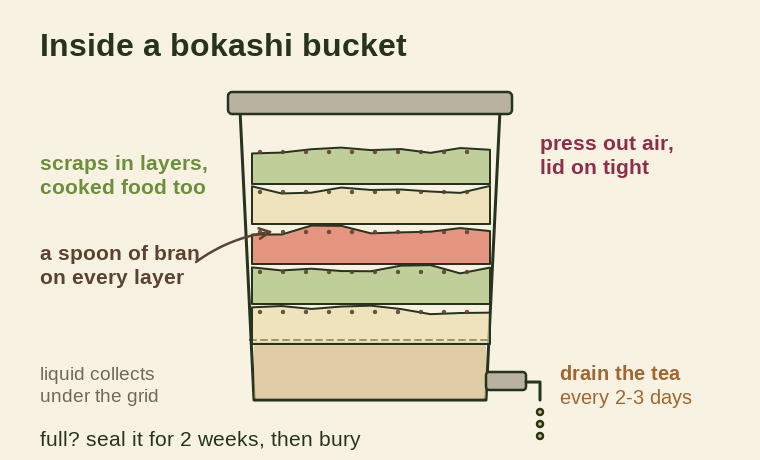
Bokashi is fermentation rather than rotting. Food scraps, including cooked food, meat and dairy, are pressed into an airtight bucket with bran inoculated with microbes. After about two weeks, the pickled scraps are buried in soil or added to a compost bin, where they break down within a few weeks. It suits small kitchens and complete food waste, but you need to buy or make bran and drain the liquid every few days. See our bokashi guide for details.
Matching a system to your situation
- Balcony or flat, no soil: bokashi, a worm bin, or both together.
- Small garden, mostly kitchen scraps: a cone bin or a worm bin, plus a bag for leaves.
- Patio, want results fast: a tumbler, filled in batches.
- Large garden with lots of garden waste: two or three slatted bays, with a cone bin or heap for overflow.
Common questions
Do compost bins need a base? Bins on soil usually do better without a solid base, because drainage and soil life can move in. On paving, add a layer of twigs or straw at the bottom, and expect some brown liquid to seep out.
Is a tumbler faster than a heap? It can be, if it is filled in a single batch with a balanced mix and turned often. A tumbler topped up every day behaves much like a slow bin.
Where should a compost bin go? Somewhere level, easy to reach in all weather and partly shaded, a little way from walls and fences.
Can I use more than one system? Yes, and it often works best: bokashi or worms for food scraps, and a heap or bays for bulky garden material.
Pick the system that fits your waste and your time, and keep feeding it a mix of greens and browns. Any of these bins makes compost; the right one makes it feel easy.
Keep reading
-
 Composting
Hot Composting: Build a Pile That Heats Up and Finishes in Weeks
How to build a hot compost pile that reaches 55-65 °C, how often to turn it, how to read a compost thermometer, and how to fix a pile that won't heat up.
-
 Composting
Bokashi Composting: How to Ferment Food Scraps, Including Meat and Dairy
How a bokashi bucket works, what you need, the step-by-step routine, what to do with the fermented scraps and how to tell a good batch from a bad one.
-
 Composting
How to Start Composting at Home: A Beginner's Setup That Actually Works
Choose a bin, find the right spot, learn the two ingredients that matter, and get your first finished compost in three to six months.
More in Composting
- Hot Composting: Build a Pile That Heats Up and Finishes in Weeks
- What Not to Compost: 15 Things to Keep Out of a Home Bin
- How to Make Leaf Mold: Turn Fallen Leaves Into Free Soil Conditioner
- Bokashi Composting: How to Ferment Food Scraps, Including Meat and Dairy
- Vermicomposting for Beginners: How to Set Up and Run a Worm Bin
- The Green and Brown Compost Ratio, Explained Without the Math Headache
- How to Start Composting at Home: A Beginner's Setup That Actually Works
- When Is Compost Ready? 6 Simple Tests for Finished Compost