
Upcycling Wooden Pallets: Safe Stamps, Prep and Simple Projects
How to read the HT and MB stamps on a wooden pallet, which pallets to avoid, how to take one apart safely, and four simple builds: planter, bench, compost bay and shelf.
On this page
Wooden pallets are everywhere: stacked behind shops, left at building sites, given away online. Each one is a ready-made pile of seasoned boards, and with a little work they become planters, benches, shelves and compost bins for the cost of some screws.
Not every pallet is a good candidate, though. Some have been treated with chemicals, some have soaked up spills, and some belong to a company that wants them back. A couple of minutes checking the stamp and the condition of the wood is what makes pallet projects safe.
Reading the pallet stamp
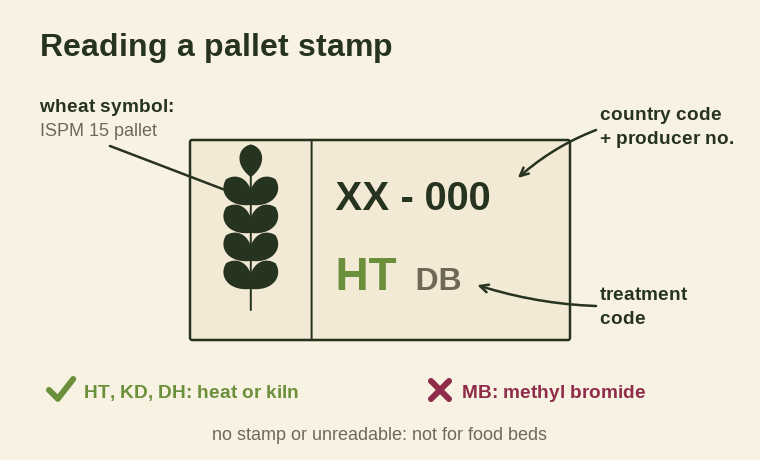
Pallets used in international shipping must be treated to kill insects and diseases under an international standard called ISPM 15. Treated pallets carry a square stamp, usually on two opposite sides of the block or stringer.
The stamp typically shows:
- A wheat-ear symbol, which marks it as meeting the standard.
- A two-letter country code, such as US, GB, DE or CN.
- A producer or treatment facility number.
- A treatment code, the part that matters most.
| Code | Meaning | Use it? |
|---|---|---|
| HT | Heat treated: the wood core held at 56 °C for at least 30 minutes | Yes, the safest choice |
| KD | Kiln dried (often seen alongside HT) | Yes |
| DB | Debarked, required on all ISPM 15 pallets | Neutral, look for the treatment code |
| DH | Dielectric heating, a newer heat method | Yes |
| MB | Fumigated with methyl bromide, a toxic pesticide | No, avoid |
| No stamp | Domestic pallet, treatment unknown | Use with care, not for food beds |
Methyl bromide has been banned for this use in the EU since 2010 and phased down in many other countries, but older and imported pallets with the MB mark still turn up.
Pallets to skip
Even with a good stamp, leave a pallet behind if:
- It has dark stains, an oily feel or a chemical smell. Pallets carry everything from food to solvents, and spills soak in.
- It is painted a solid color, such as blue or red. Colored pallets are often part of rental pools owned by pallet companies; taking them can amount to theft.
- It is moldy, rotten or split badly.
- You do not know where it came from and you plan to grow food in it.
Always ask before taking pallets from a business. Many are happy to give away one-way pallets, but others are collected and reused.
Preparing pallet wood safely
- Wear gloves and eye protection. Pallets shed splinters and hide bent nails and staples.
- Scrub it with a stiff brush and soapy water, then let it dry for a few days.
- Take it apart, or don't. Many projects use the pallet whole. To get boards, cut the slats next to the blocks with a reciprocating saw, or lever them off gradually with a pry bar, working from both sides so the wood does not split.
- Pull or cut every nail. Pallet nails are often ring-shanked and grip hard; cutting them flush is sometimes easier than pulling.
- Sand any surfaces that will be sat on or touched.
- Finish outdoor projects with a plant-based oil or exterior wood stain if you want them to last longer, but keep finishes off surfaces in contact with food-growing soil.
Never burn pallet offcuts indoors or in a stove unless you know they are untreated, and never burn painted or MB-stamped wood at all.
Four simple projects
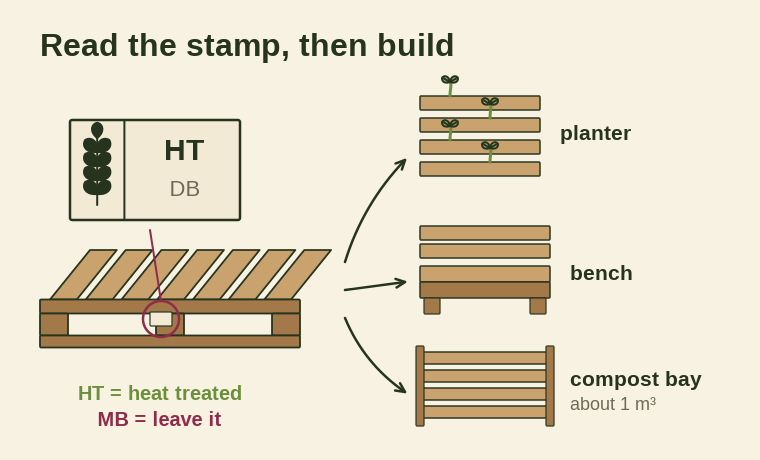
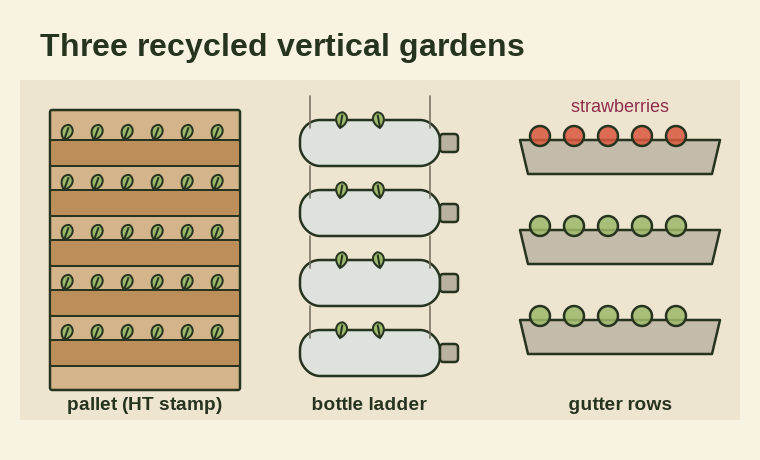
1. Vertical planter. Stand a pallet upright, staple landscape fabric behind and below each gap between slats to form pockets, fill with potting mix and plant herbs, strawberries or trailing flowers. Water often, because pockets dry fast. Our vertical garden guide has planting ideas.
2. Garden bench. Two whole pallets stacked and screwed together make a low seat. A third pallet fixed upright at the back becomes a backrest. Add a cushion and you have patio seating for almost nothing.
3. Compost bay. Four HT pallets standing on edge, tied at the corners with strong wire or screwed to corner posts, make a bay about 1 m³. That is the size that holds heat well in a hot compost pile. Make the front pallet removable for easy turning. Our comparison of compost bin types explains when a bay beats a plastic bin.
4. Wall shelf. Cut a pallet across, just below the second row of slats, so you get a section with slats on the front and a board along the bottom. Nail a spare board across the bottom to make a shelf, sand it and screw it securely into wall studs or plugs.
Is pallet wood safe for vegetable beds?
HT pallets in good condition are generally considered fine for edging beds and making compost bins. The cautious approach is to use pallet wood for frames and paths rather than as a liner touching soil for root crops, to line the inside with cardboard or fabric, and to avoid anything stained or of unknown origin. For a permanent food bed, purpose-bought untreated timber is a better long-term choice, as our raised bed guide explains.
Common questions
What if the stamp is faded? If you cannot read the treatment code, treat it like an unstamped pallet: fine for a shelf or bench, not for growing food.
How long will a pallet project last outdoors? Untreated pallet wood is usually softwood and may last only a few years in contact with wet soil. Raising it on bricks and oiling it helps.
Is it legal to take pallets left outside a shop? Not always. Ask first, even if they look abandoned.
Can I compost old pallet wood? Small amounts of untreated, unpainted HT wood will rot slowly in a heap. Remove all nails first.
With a quick look at the stamp and a sensible prep routine, pallets are some of the most useful free materials a gardener can find. Start with one small project, and you will start noticing them everywhere.
Keep reading
-
 Composting
Choosing a Compost Bin: Heaps, Bays, Tumblers, Worms and Bokashi
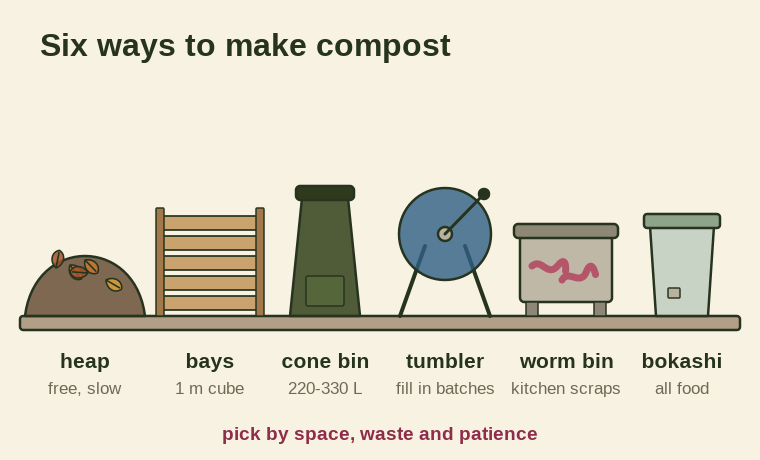
Open heap, slatted bays, plastic cone bin, tumbler, worm bin or bokashi bucket? What each compost system is good at, its drawbacks, and how to pick one for your space.
-
 Reuse & Upcycling
12 Practical Ways to Reuse Cardboard Boxes at Home and in the Garden
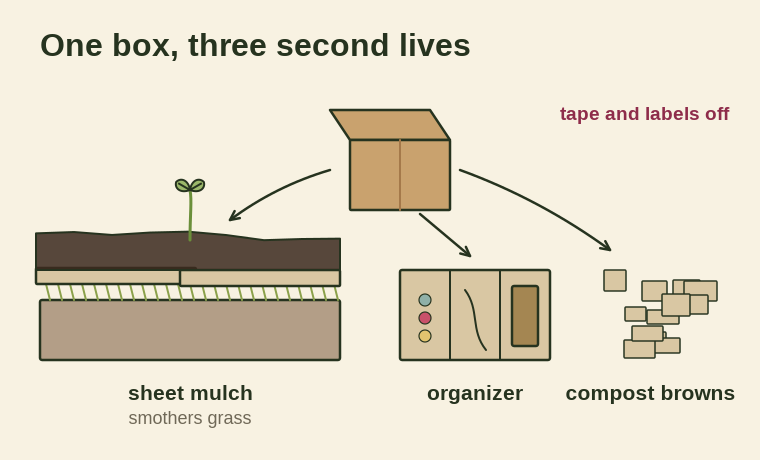
Before you flatten that box for recycling, put it to work. Sheet mulching, seed trays, storage, compost browns, kids' projects and more, plus which cardboard to avoid.
-
 Small-Space Gardening
Build a Vertical Garden From Recycled Materials: Pallets, Bottles and Gutters
Three vertical garden builds using reclaimed materials, with what to grow in each, how to water them, and the safety checks to do first.
More in Reuse & Upcycling
- Reuse Tin Cans: Planters, Organizers and Lanterns Made Safely
- 12 Practical Ways to Reuse Cardboard Boxes at Home and in the Garden
- DIY Seed Pots From Newspaper, Toilet Rolls and Egg Cartons
- Visible Mending for Beginners: Darning, Patching and Sashiko-Style Stitches
- What to Do With Old T-Shirts: 8 No-Sew and Simple-Sew Upcycling Projects
- How to Make a Self-Watering Planter From a Plastic Bottle
- 15 Practical Ways to Reuse Glass Jars Around the House
- DIY Bird Feeders From Recycled Materials: 4 Easy Designs