
When Is Compost Ready? 6 Simple Tests for Finished Compost
How to tell if your compost is finished: look, smell, temperature, the bag test and a cress germination test, plus why curing matters and how to sieve it.
On this page
Compost does not come with a timer. A pile started in spring might be ready by autumn, or it might need another year, depending on what went in, how big the pile is and how often it was turned. The good news is that finished compost is easy to recognize once you know what to look for, and there are two simple tests that remove any doubt.
Using compost too early is a common beginner mistake, and waiting a few extra weeks costs nothing, so it pays to check before you spread.
Why "finished" matters
While compost is still active, microbes are busy breaking down fresh material. If you dig that into soil, they keep going, and they take nitrogen from the soil to do it. This is called nitrogen tie-up, and it can leave plants pale and slow for weeks. Immature compost can also contain ammonia and organic acids that damage tender roots and stop seeds from germinating.
Mature compost is stable, and gentle enough to sow seeds into. If you are new to the process, our guide to starting a compost pile at home explains how a pile moves from scraps to soil.
The quick checks: look, feel, smell
| Check | Ready | Not ready yet |
|---|---|---|
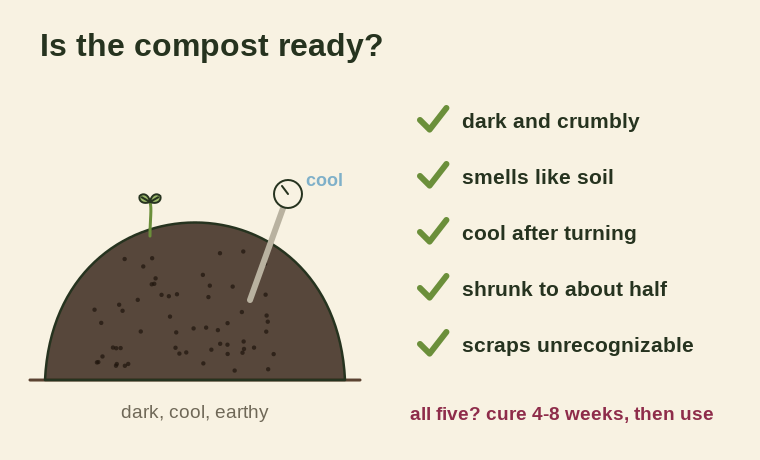
| Color | Dark brown to almost black | Patches of green, yellow or original colors |
| Texture | Crumbly, like moist chocolate cake | Slimy, matted or stringy |
| Ingredients | Mostly unrecognizable | You can still see peels, leaves, grass |
| Smell | Earthy, like a forest floor | Sour, rotten or ammonia |
| Volume | Shrunk to about half or less | Close to the original size |
| Temperature | Same as the air, even after turning | Warm in the middle, or heats up again |
A few tough items, such as eggshell pieces, avocado skins, corn cobs or woody stems, often survive. That does not mean the batch is unfinished. Sieve them out and put them back in the next pile.
The temperature test
Temperature is the most reliable sign that decomposition has slowed. An active pile, especially a hot compost pile, runs warmer than the surrounding air. When it is close to finished, it stays cool.
- Push a compost thermometer, or your hand, into the center of the pile.
- If it feels warm, the pile is still working. Leave it.
- If it is cool, turn the pile thoroughly and add water if it is dry.
- Check again after 3 to 5 days. If it does not warm up again, the active phase is over.
A pile that heats up again still has food left for the microbes.
The bag test
This test catches compost that looks ready but is still releasing gases.
- Take a couple of handfuls from the middle of the pile. It should be moist but not dripping.
- Seal it in a plastic bag or a jar with a lid.
- Leave it at room temperature for 3 to 7 days.
- Open it and smell it straight away.
If it smells earthy, it is ready. If it smells sour, rotten or sharp like ammonia, it needs more time in the pile, with turning and air.
The germination test
This is the best test if you plan to use compost for seed sowing or potting.
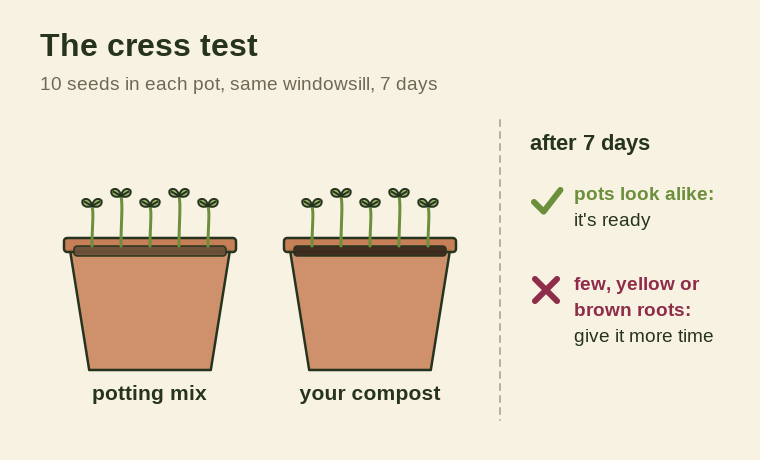
- Fill one small pot with your compost and another with bought seed or potting mix.
- Sow 10 cress or radish seeds in each. Both germinate in a few days.
- Water them equally and keep them on the same windowsill.
- After about 7 days, compare: count the seedlings and look at their color and roots.
If the compost pot has a similar number of healthy green seedlings, the compost is mature. If few seeds came up, or the seedlings are yellow, twisted or have brown root tips, the compost still contains compounds that harm young plants.
Curing: the step most people skip
Even when the active phase is over, compost benefits from curing: sitting quietly for another 4 to 8 weeks. During this time, fungi and other organisms finish breaking down tougher material, the texture becomes finer, and any remaining harsh compounds fade.
To cure compost, move it to a separate bay or corner, or simply stop adding to the bin. Keep it moist and cover it so rain does not wash out nutrients. If you only have one bin, look at our comparison of compost bin types: a second bin or a two-bay system makes curing much easier.
Sieving finished compost
You do not have to sieve compost. For mulching and digging into beds, rough compost is fine. For seed trays and homemade potting mix, a finer texture helps.
- For mulch and soil improvement: use it as it is, or pick out the largest lumps.
- For potting mix: sieve through a mesh of about 1 to 1.5 cm (around 1/2 inch). A frame of wood with hardware cloth stapled underneath, set over a wheelbarrow, works well.
- For seed sowing: sieve finer, around 6 mm, and mix with other ingredients as described in our DIY potting mix recipes.
Whatever stays in the sieve goes back into the next pile as a starter.
How long it usually takes
Timing depends on the method and the materials.
- Hot composting, turned often: active phase in about 1 to 3 months, plus curing.
- Cool pile, turned now and then: about 6 to 12 months.
- Cold heap, never turned: 1 to 2 years.
Balanced greens and browns, chopped material and steady moisture all speed things up.
Common questions
Can I use compost that still has a few bits in it? Yes, for beds and mulch. Scattered twigs or eggshells do no harm. For pots and seed trays, sieve them out.
My compost smells of ammonia. What went wrong? Too much nitrogen-rich green material, such as grass clippings. Mix in dry browns like shredded cardboard or leaves and turn the pile. Our green and brown ratio guide has the details.
Can compost be "too old"? Not really. Compost stored for a long time slowly loses some nitrogen, especially if rain soaks it, but it remains an excellent soil improver. Keep it covered.
Checking compost takes a few minutes and a handful of seeds. Once it looks dark, smells of soil, stays cool and grows healthy cress, you can spread it with confidence.
Keep reading
-
 Composting
Hot Composting: Build a Pile That Heats Up and Finishes in Weeks
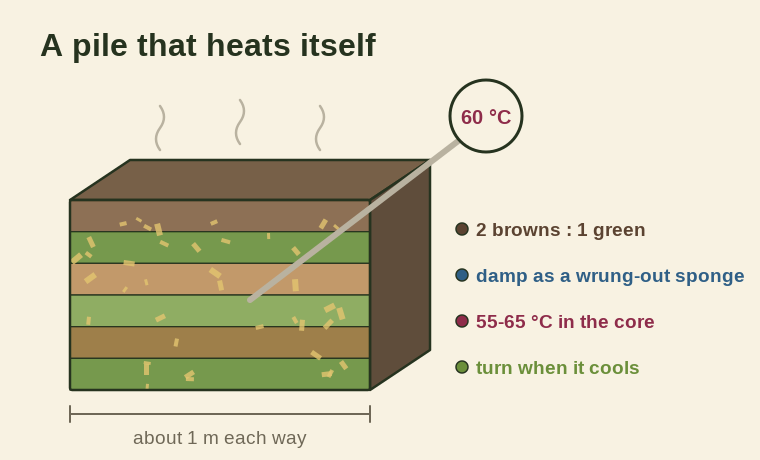
How to build a hot compost pile that reaches 55-65 °C, how often to turn it, how to read a compost thermometer, and how to fix a pile that won't heat up.
-
 Small-Space Gardening
DIY Potting Mix: Simple Peat-Free Recipes for Pots, Seeds and Herbs
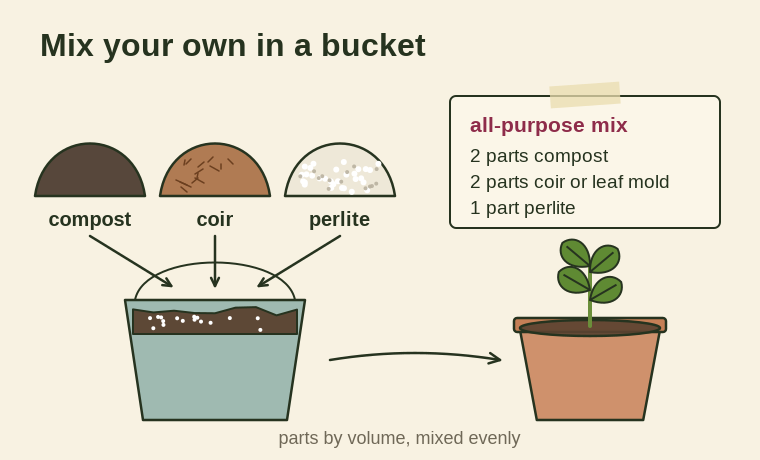
Make your own peat-free potting mix with compost, coir or leaf mold and perlite. Recipes for containers, seed sowing and herbs, plus why garden soil fails in pots.
-
 Composting
How to Start Composting at Home: A Beginner's Setup That Actually Works
Choose a bin, find the right spot, learn the two ingredients that matter, and get your first finished compost in three to six months.
More in Composting
- Choosing a Compost Bin: Heaps, Bays, Tumblers, Worms and Bokashi
- Hot Composting: Build a Pile That Heats Up and Finishes in Weeks
- What Not to Compost: 15 Things to Keep Out of a Home Bin
- How to Make Leaf Mold: Turn Fallen Leaves Into Free Soil Conditioner
- Bokashi Composting: How to Ferment Food Scraps, Including Meat and Dairy
- Vermicomposting for Beginners: How to Set Up and Run a Worm Bin
- The Green and Brown Compost Ratio, Explained Without the Math Headache
- How to Start Composting at Home: A Beginner's Setup That Actually Works