
Epsom Salt in the Garden: What It Really Does and When to Use It
Epsom salt supplies magnesium and sulfur, not miracles. What magnesium does, how to spot a real deficiency, which popular claims are myths, and the risks of overuse.
On this page
Few garden tips spread as widely as Epsom salt. It is said to make tomatoes sweeter, peppers more productive, roses bloom harder and lawns greener. It is cheap, it dissolves easily, and it feels harmless. The truth is less exciting: Epsom salt is a useful fix for one specific problem, magnesium deficiency, and does little or nothing for plants that are not short of magnesium.
This guide explains what is in it, how to tell whether your plants need it, and why adding it "just in case" can sometimes do harm.
What Epsom salt actually is
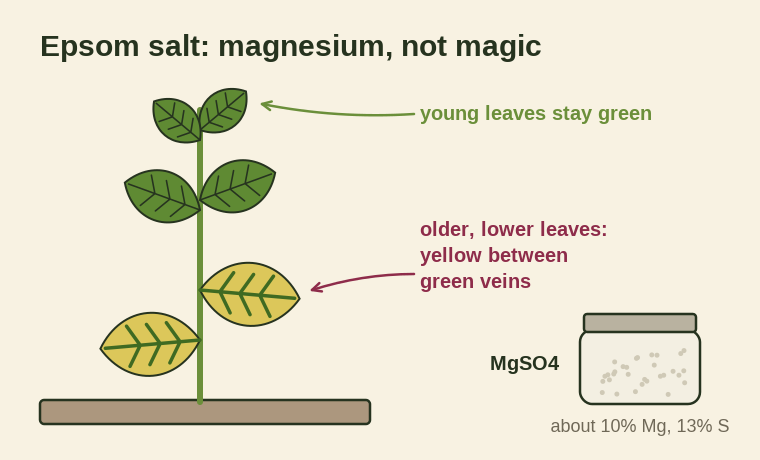
Epsom salt is magnesium sulfate, a mineral salt (it contains no sodium chloride, so it is not like table salt). The common form sold for baths and gardens is about 10% magnesium and 13% sulfur by weight, with the rest made up mostly of water bound into the crystals.
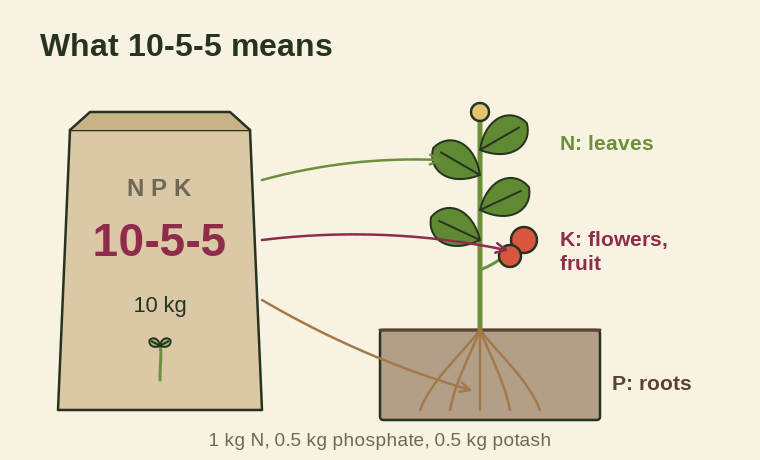
Both nutrients are genuine plant needs, but neither is part of the N-P-K numbers on a fertilizer bag. They are called secondary nutrients: needed in smaller amounts than nitrogen, phosphorus and potassium, but more than trace elements. If those labels confuse you, see how to read a fertilizer label.
What magnesium does for plants
Magnesium sits at the center of every chlorophyll molecule, the green pigment that captures light. Without enough of it, leaves cannot photosynthesize properly. It also helps activate many enzymes and move sugars around the plant.
Sulfur is used to build proteins and gives onions, garlic and cabbage family plants their strong flavors. Sulfur deficiency is less common in gardens, because organic matter usually supplies enough, though it can show up on sandy, low-organic soils.
How to recognize magnesium deficiency
Magnesium is mobile inside the plant. When it runs short, the plant moves it from old leaves to new growth, so symptoms appear on older, lower leaves first.
- Yellowing between the veins, while the veins themselves stay green (called interveinal chlorosis).
- Sometimes reddish or purple tints on the yellowing areas.
- In bad cases, the yellow patches turn brown and the leaves drop early.
Other problems can look similar. Nitrogen shortage also yellows old leaves first, but the whole leaf turns pale, veins included. Iron shortage causes yellowing between the veins too, but on the youngest leaves at the tips. Cold, waterlogged roots can mimic any of these.
Myths versus evidence
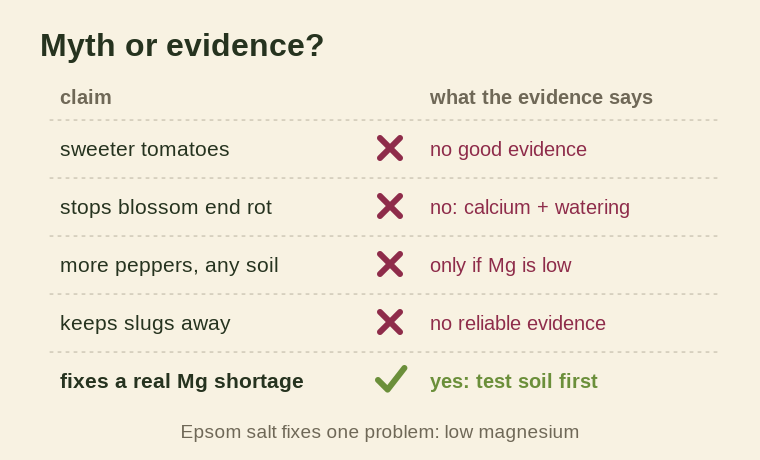
| Claim | What the evidence says |
|---|---|
| Makes tomatoes sweeter or bigger | No good evidence on soil with normal magnesium |
| Prevents blossom end rot | No. That is a calcium problem linked to uneven watering, and extra magnesium can make it worse |
| More peppers on every plant | Only helps if the soil is genuinely short of magnesium |
| Deters slugs and pests | No reliable evidence |
| Greens up yellow plants | Only if the yellowing is caused by magnesium deficiency |
| Should be added at every planting | Not needed in most garden soils |
The blossom end rot myth deserves attention. Magnesium and calcium compete for uptake by roots, so adding magnesium to a tomato that already struggles with calcium can increase the problem. Steady, deep watering and mulch are the real fix, as explained in our tomato growing guide.
When Epsom salt can help
There are situations where magnesium shortages are more likely:
- Sandy, acidic soils in high-rainfall areas, where magnesium washes out.
- Soils with very high potassium, often from heavy use of potassium fertilizers or lots of wood ash. Too much potassium blocks magnesium uptake. See wood ash in the garden for safe amounts.
- Container plants in peat-free or soilless mixes fed only with a fertilizer that contains no magnesium. Many general fertilizers already include it, so check the label.
- Hungry crops in pots, such as tomatoes and peppers grown in containers, late in the season.
If the soil is acidic and low in magnesium, dolomitic lime may be the better choice, because it supplies magnesium and calcium while raising pH. If pH is already fine, Epsom salt adds magnesium without changing it.
How to use it
If a soil test or clear symptoms point to a shortage:
- Foliar spray for a quick fix. A commonly recommended rate is about 1 tablespoon (roughly 15 g) dissolved in 4 liters of water. Spray the leaves in the evening or on a cloudy day, so they don't scorch in strong sun.
- Repeat every 2 to 3 weeks if symptoms continue. New leaves should come out green; already damaged leaves will not fully recover.
- Fix the soil for the longer term at the rate your soil test suggests, rather than a guessed handful.
- Watch the plant. If new growth stays yellow, magnesium was probably not the problem.
Risks of overuse
Epsom salt is not toxic in normal garden amounts, but "more" is not "better":
- It dissolves and washes out fast, so excess ends up in drains and streams instead of the plant.
- It can unbalance other nutrients. Too much magnesium can reduce uptake of calcium and potassium.
- It adds salts. In pots, small dry beds and dry climates, built-up salts can burn roots and leaf edges.
- It wastes money when the real issue is watering, pH, light or nitrogen.
Common questions
Can I use bath salts with added scent? Avoid them. Fragrances, oils and dyes are not meant for soil. Use plain, unscented magnesium sulfate.
Does Epsom salt help seeds germinate? There is no good evidence that it does. Seeds carry their own nutrients for the first days.
Is it organic? Natural mined magnesium sulfate is permitted in many organic systems, usually only when a deficiency is documented. Rules vary, so check your local certification standards if that matters to you.
Will it help my lawn? Only on soil that tests low in magnesium. For most lawns, mowing high and leaving clippings matter more.
Epsom salt is a good tool for one job. Test first, treat a real magnesium shortage, and skip it the rest of the time. Your plants, your wallet and the nearest stream will all be better off.
Keep reading
-
 Natural Fertilizers
How to Read a Fertilizer Label: N-P-K Numbers Explained Simply
What the three N-P-K numbers on a fertilizer bag mean, what nitrogen, phosphorus and potassium do, why organic numbers look low, and how to spot deficiencies.
-
 Growing Food
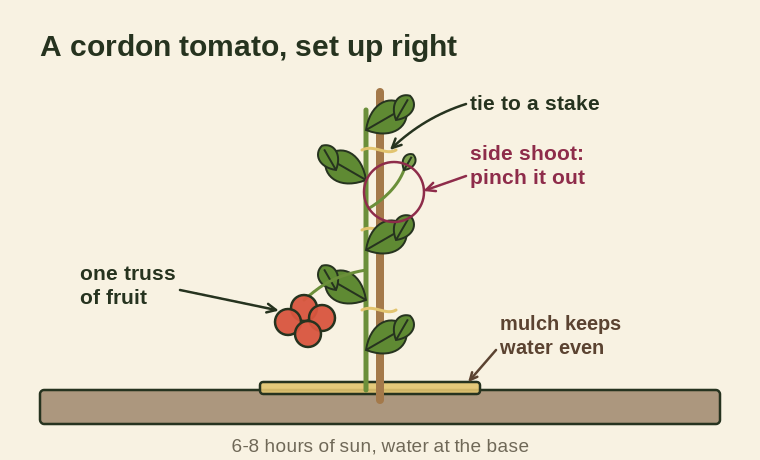
How to Grow Tomatoes: A Beginner's Guide From Seed to Harvest
Choosing varieties, when to plant, staking, watering, feeding, pinching side shoots, and fixing the common problems like split fruit, blossom end rot and blight.
-
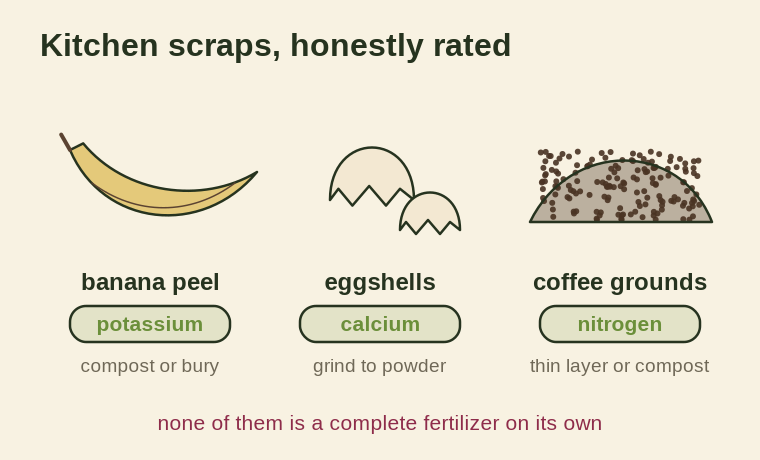 Natural Fertilizers
Banana Peels, Eggshells and Coffee Grounds: Which Kitchen Fertilizers Really Work
An honest look at popular kitchen scrap fertilizers, what nutrients they actually supply, and the right way to use each one.
More in Natural Fertilizers
- How to Use Worm Castings: Top Dressing, Potting Mix and Worm Tea
- How to Read a Fertilizer Label: N-P-K Numbers Explained Simply
- How to Use Manure in the Garden Safely: Types, Aging and Amounts
- Cover Crops and Green Manure: How to Feed Your Soil With Plants
- Comfrey and Nettle Tea: Homemade Liquid Fertilizers From Weeds
- Using Wood Ash in the Garden: Benefits, Limits and Safe Amounts
- Banana Peels, Eggshells and Coffee Grounds: Which Kitchen Fertilizers Really Work
- How to Make Compost Tea: Simple Steeped and Aerated Methods