
Greywater: How to Reuse Shower and Laundry Water in the Garden Safely
What greywater is, which sources are safe, which soaps to use, simple ways to collect it from a bucket to a laundry-to-landscape system, and the plants and rules to keep in mind.

On this page
Every day, a typical home sends dozens of liters of lightly used water down the drain from showers, bathroom sinks and the washing machine. This greywater is only slightly dirty, and with a little care it can water trees, shrubs and flower beds instead of being wasted. In dry summers or places with water restrictions, it can keep a garden alive.
This guide covers what's safe, what isn't, and how to start simply.
What counts as greywater
| Source | Greywater? | Notes |
|---|---|---|
| Shower and bath | Yes | Easiest and cleanest source |
| Bathroom sink | Yes | Small volumes; avoid if toothpaste-heavy |
| Washing machine | Yes | Large volumes; great for laundry-to-landscape |
| Kitchen sink | Usually no | Food, fats and grease; many rules exclude it |
| Dishwasher | Usually no | Salty, very alkaline detergents |
| Toilet | No | This is blackwater and must go to the sewer or septic system |
| Water used to wash diapers | No | Treat as blackwater |
The safety rules
Greywater can carry bacteria, soap and small amounts of other chemicals. These rules keep it safe:
- Use it quickly. Don't store greywater for more than 24 hours. Stored greywater goes stale and smelly, and bacteria multiply.
- Get it into the soil, not into the air. Apply it under mulch or directly to soil. Never use it in a sprinkler or spray system.
- Don't let it pool or run off into streets, drains, streams or neighbors' gardens.
- Keep it away from food you eat raw. Use greywater on trees, shrubs, flowers and fruit trees, not on lettuce, carrots or anything where the edible part touches the soil.
- Skip it when someone is sick, or after washing very dirty items like work clothes covered in chemicals or diapers.
- Keep kids and pets away from greywater outlets.
Choose garden-friendly products
What goes down your drain ends up in your soil, so the products you use matter.
- Avoid sodium-heavy products. Many powders and some liquids are high in sodium salts, which build up in soil and damage its structure. Liquid detergents are usually lower in salt than powders.
- Avoid boron (borax). Plants are sensitive to it even in small amounts.
- Skip bleach, softeners and antibacterial soaps on days you use greywater. Divert that water to the sewer instead.
- Look for products labeled greywater-safe or "plant-friendly". Our zero-waste laundry guide has tips on using less detergent, which also helps.
Three ways to start
1. The bucket (no plumbing at all)
Keep a bucket in the shower to catch water while it warms up and while you wash. That warm-up water is actually clean tap water and can be used anywhere, even on vegetables. Shower water can then be carried to trees and shrubs. It's simple, but buckets are heavy, so this is best for small amounts.
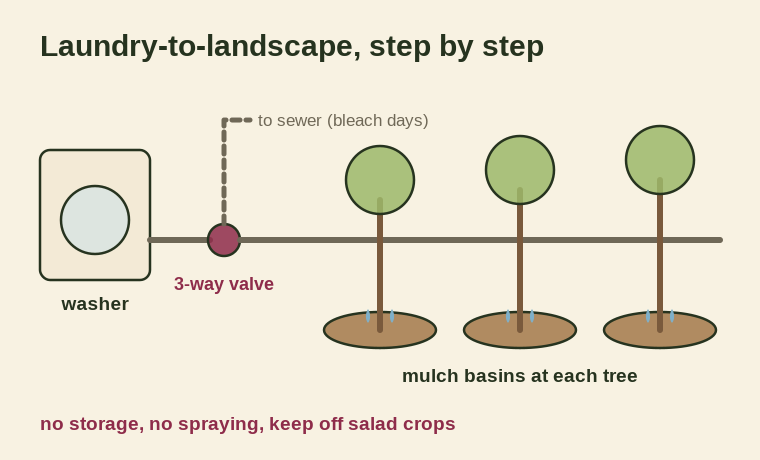
2. Laundry-to-landscape
This is the simplest permanent system and one of the most popular. The washing machine's own pump pushes water through a pipe to the garden, with no tank and no extra pump.
- A three-way valve on the machine's outlet hose lets you choose garden or sewer. Switch to sewer for bleach loads.
- A 25 mm (1 inch) pipe runs out of the house and along the garden.
- Small outlets release water into mulch basins: shallow dips around trees or shrubs, filled with wood chips.
- The mulch filters lint and soap and spreads water into the soil.
Each basin should cover the root zone of the plant. A small fruit tree might get one basin of about 1 square meter.
3. Branched drain from the shower
A gravity-fed system that sends shower water through pipes that split into several mulch basins. It needs a bathroom higher than the garden and more plumbing work, so it's usually done when renovating, often with a plumber.
Which plants like greywater
Greywater is slightly alkaline, so it suits most plants, but some are better choices than others:
- Great: fruit trees (citrus, apple, fig, plum), bananas, roses, berries such as raspberries and blackberries, ornamental shrubs and established hedges.
- Fine with care: lawns, if applied below the surface; perennial flowers.
- Avoid: acid-loving plants like blueberries, azaleas and rhododendrons; seedlings; root vegetables and salad crops.
Rotate where you apply greywater, and let rain or occasional fresh water flush the soil now and then to prevent salt build-up.
Combine it with other water savings
Greywater works best alongside other steps:
- Rain barrels for clean water on vegetables.
- Mulch to cut evaporation everywhere.
- Drip irrigation for efficient fresh-water watering.
- Fixing leaks and using less indoors, as in our water saving guide.
Common questions
How much greywater does a home make? A typical washing machine load produces 50 to 100 liters, and a shower about 8 to 12 liters per minute. Even one source can cover several trees.
Will it smell? Not if it goes straight into mulch and is never stored. Smell means water is pooling or sitting too long.
Can I use greywater on my vegetable garden? Only on crops like fruit trees or tall plants where the edible part doesn't touch the water or soil, and applied under mulch. Keep it off leafy greens and root crops.
Greywater is one of the most practical ways to use the same water twice. Start with a bucket in the shower, use plant-friendly soap, send it into mulch around trees, and your garden can stay green with less fresh water.
Keep reading
-
 Water & Energy
How to Save Water at Home: Where It Goes and 12 Ways to Use Less
Showers, toilets, leaks and laundry use most household water. How to find leaks, the fixes that save the most, and how to reuse water safely in the garden.
-
 Water & Energy
Drip Irrigation for Home Gardens: A Simple System You Can Install in a Day
How drip irrigation saves water, the parts you need, how to plan and lay out lines, and how to run a low-pressure system from a rain barrel.
-
 Water & Energy
Rainwater Harvesting at Home: How to Set Up a Rain Barrel
How much water a roof collects, how to connect a barrel to a downspout, keep mosquitoes and algae out, and use rainwater safely in the garden.
More in Water & Energy
- Mulching to Save Water: The Easiest Way to Cut Garden Watering
- How to Save Water at Home: Where It Goes and 12 Ways to Use Less
- How to Save Energy at Home: 15 Simple Steps Ranked by Impact
- Drip Irrigation for Home Gardens: A Simple System You Can Install in a Day
- Rainwater Harvesting at Home: How to Set Up a Rain Barrel
- How to Keep Your Home Cool Without AC: Shade, Night Air and Fans
- Water-Wise Gardening: Drought-Tolerant Plants and Smarter Watering
- Draft-Proofing Your Home: Find and Seal Drafts the Safe Way