
Water-Wise Gardening: Drought-Tolerant Plants and Smarter Watering
Grow a garden that needs far less water: drought-tolerant plants, grouping them by thirst, soil that holds moisture, deep watering, and alternatives to a thirsty lawn.
On this page
Outdoor watering is one of the biggest uses of water in many homes. The US Environmental Protection Agency estimates that landscape irrigation accounts for nearly a third of residential water use, and that a large share of it is lost to evaporation, runoff and overwatering. Hot, dry summers and hosepipe bans are making that harder to ignore.
A water-wise garden is not a gravel yard with three cacti. It can be full of flowers, herbs and food. The idea is to choose plants that suit your rainfall, group them by how much water they need, build soil that holds moisture, and water deeply but rarely. Together, these steps can cut garden watering dramatically.
How drought-tolerant plants cope
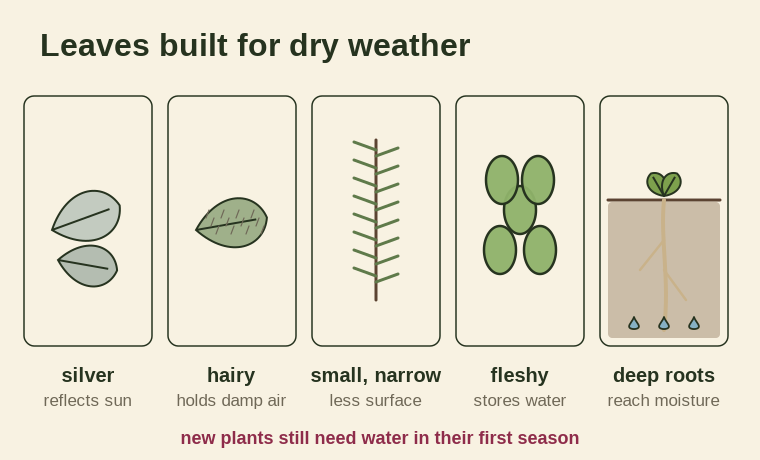
Plants from dry climates have evolved clever ways to save water. You can often spot them by their leaves:
- Silver or gray leaves reflect sunlight and stay cooler. Think lavender, artemisia and lamb's ears.
- Hairy or felted leaves trap a layer of still, humid air that slows water loss.
- Small, narrow or needle-like leaves have less surface to lose water from, like rosemary and thyme.
- Thick, fleshy leaves store water, as in sedums and other succulents.
- Deep or spreading roots reach moisture other plants can't, which is why many prairie plants survive droughts.
Plants to start with
The best choices depend on your climate, so look first at plants native to your region, which are adapted to local rainfall and support local wildlife. These widely grown plants tolerate dry spells in many temperate gardens once established:
| Plant | Type | Notes |
|---|---|---|
| Lavender | Shrub | Full sun, sharp drainage, loved by bees |
| Rosemary, sage, thyme, oregano | Herbs | Mediterranean, dislike wet roots |
| Russian sage | Perennial | Tall silvery stems, late summer flowers |
| Yarrow | Perennial | Flat flower heads, spreads gently |
| Sedums (stonecrops) | Succulent perennials | Late flowers for pollinators |
| Coneflower and black-eyed Susan | Perennials | Prairie natives with deep roots |
| Catmint | Perennial | Long flowering, easy |
| Blue fescue and other ornamental grasses | Grasses | Movement and texture |
| California poppy | Annual | Self-seeds in poor, dry soil |
"Drought tolerant" means once established. Every new plant needs regular watering for its first growing season, often its first year, while roots spread. Planting in autumn or early spring, when rain does some of the work, makes establishment easier.
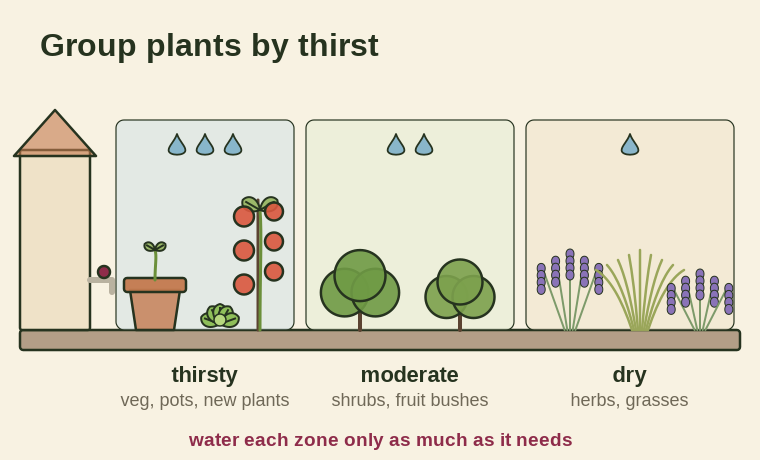
Group plants by thirst
Gardeners call this hydrozoning: putting plants with similar water needs together so you can water each area the right amount.
- High-water zone, closest to the house and tap: vegetables, containers, new plantings and a small lawn if you want one.
- Moderate zone: shrubs, fruit bushes and perennials that need a drink in long dry spells.
- Low-water zone, furthest away or in the hottest, driest spots: Mediterranean herbs, grasses and drought-tolerant perennials that rarely need watering after their first year.
Mixing thirsty and tough plants in the same bed means either drowning the tough ones or starving the thirsty ones. Grouping avoids both.
Build soil that holds water
Soil is the garden's water tank. Organic matter such as compost and leaf mold helps sandy soil hold water and helps clay soil let water in instead of running off. Spread 3 to 5 cm of compost on beds each year.
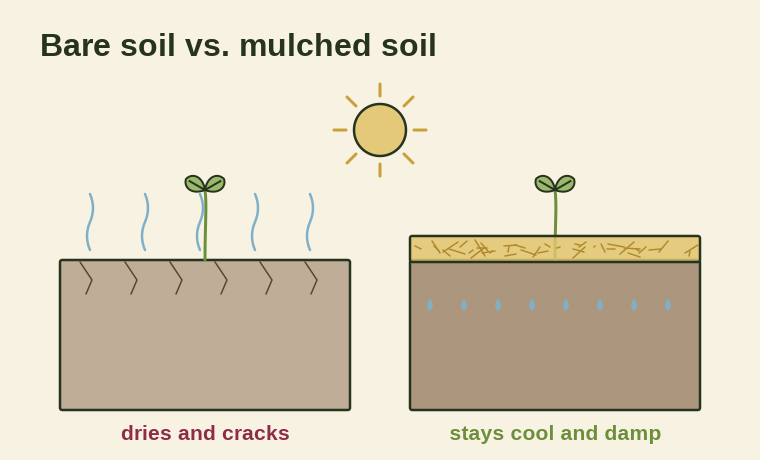
Then cover the surface with 5 to 8 cm of mulch, kept a few centimeters away from stems. Mulch shades the soil, slows evaporation and keeps roots cool. Our guide to mulching to save water compares materials. Mediterranean herbs prefer a mulch of gravel rather than rich compost.
Water deeply, early and less often
How you water matters as much as what you grow.
- Check before you water. Push a finger 5 cm into the soil. If it is still damp, wait.
- Water deeply. A thorough soak every few days encourages deep roots; a daily sprinkle keeps roots shallow and needy.
- Water early in the morning, when less is lost to evaporation and leaves dry before evening.
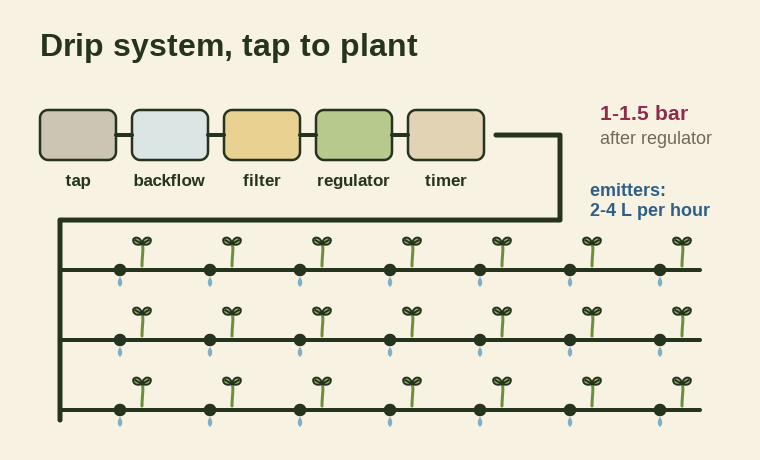
- Water the soil, not the leaves. A watering can or drip irrigation puts water where roots are and wastes far less than a sprinkler.
- Use free water. A rain barrel catches roof runoff for dry weeks.
Rethink the lawn
A traditional lawn is often the thirstiest part of a garden. Options include:
- Let it go dormant. Many cool-season lawns turn brown in drought and recover when rain returns. Mowing higher, at around 5 to 8 cm, also helps grass stay green longer.
- Add clover to an existing lawn. It stays green longer in dry spells and adds nitrogen to the soil.
- Shrink it. Keep a small lawn for play and turn edges into low-water beds.
- Try a meadow or groundcover such as creeping thyme for areas that see little foot traffic.
Common questions
Are succulents the only drought-tolerant plants? No. Many herbs, grasses, shrubs and prairie flowers handle dry spells well, and a varied planting is better for wildlife.
How often should I water a water-wise garden? New plants need regular watering in their first season. After that, low-water zones may need water only in long droughts, while vegetables still need a deep soak once or twice a week in dry weather.
Will gravel gardens get too hot? Gravel reflects heat and suits Mediterranean plants, but a garden of nothing but gravel and paving heats up and supports little life. Use it as a mulch around plants, not instead of them.
Can vegetables be water-wise? Yes, with mulch, drip watering and grouping them in one zone. Deep-rooted crops such as tomatoes, squash and beans cope better with dry spells than shallow-rooted lettuce.
Start with one change: group your plants, add mulch, or swap a thirsty bed for tough perennials. Each step means less time with the hose and a garden that copes calmly with dry summers.
Keep reading
-
 Water & Energy
Mulching to Save Water: The Easiest Way to Cut Garden Watering
How mulch keeps soil moist, which materials to use for vegetables, borders and containers, how thick to spread it, and the mistakes to avoid.
-
 Water & Energy
Drip Irrigation for Home Gardens: A Simple System You Can Install in a Day
How drip irrigation saves water, the parts you need, how to plan and lay out lines, and how to run a low-pressure system from a rain barrel.
-
 Water & Energy
Rainwater Harvesting at Home: How to Set Up a Rain Barrel
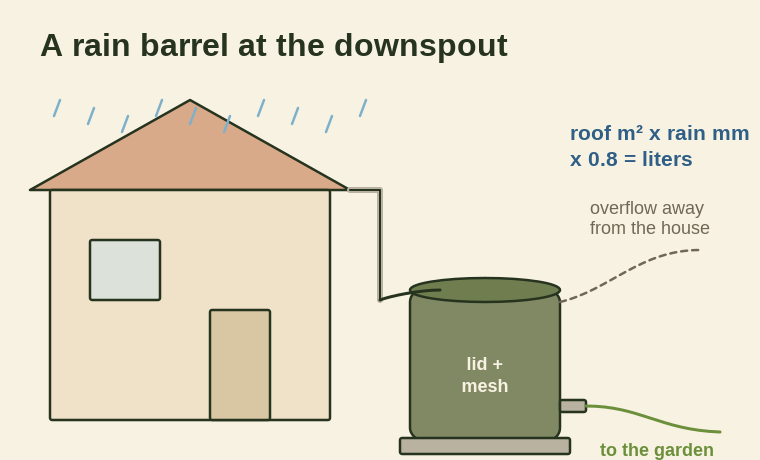
How much water a roof collects, how to connect a barrel to a downspout, keep mosquitoes and algae out, and use rainwater safely in the garden.
More in Water & Energy
- Draft-Proofing Your Home: Find and Seal Drafts the Safe Way
- Greywater: How to Reuse Shower and Laundry Water in the Garden Safely
- Mulching to Save Water: The Easiest Way to Cut Garden Watering
- How to Save Water at Home: Where It Goes and 12 Ways to Use Less
- How to Save Energy at Home: 15 Simple Steps Ranked by Impact
- Drip Irrigation for Home Gardens: A Simple System You Can Install in a Day
- Rainwater Harvesting at Home: How to Set Up a Rain Barrel
- How to Keep Your Home Cool Without AC: Shade, Night Air and Fans