
Grow Lights for Indoor Plants: A Simple Guide for Seedlings and Herbs
How to choose and use LED grow lights for seedlings, herbs and microgreens: which type to buy, how close to hang them, how many hours to run them and what they cost.
On this page
A sunny windowsill is enough for many plants in summer, but in winter, or in a dim apartment, light is the main reason indoor seedlings stretch, flop and turn pale. A grow light fixes that. It lets you start tomatoes in late winter, keep herbs going in the kitchen and grow trays of microgreens anywhere you have a shelf and a socket.
You don't need expensive equipment. A simple LED fixture and a plug-in timer will grow better seedlings than most windowsills, and the running cost is lower than many people expect.
Why windowsills often fall short
Plants respond to light very differently from our eyes. A room that looks bright to us can be far too dim for plants, because our eyes adjust. Even a south-facing window in winter gives short days, low sun and light that comes in from one side, so seedlings lean and stretch toward it.
Signs that plants need more light:
- Long, thin, pale stems (leggy seedlings) that fall over.
- Seedlings leaning hard toward the window.
- Herbs that grow slowly with small, widely spaced leaves.
Choosing a grow light
| Type | Pros | Cons | Verdict |
|---|---|---|---|
| White "full spectrum" LED | Efficient, cool, natural-looking light | Quality varies between products | Best choice for most homes |
| Red and blue (purple) LED | Efficient | Makes plants hard to inspect, harsh to live with | Works, but white is easier |
| Fluorescent tubes (T5) | Cheap, gentle, proven for seedlings | Less efficient, must be very close | Fine if you already have one |
| Ordinary incandescent bulbs | None for plants | Mostly heat, little useful light | Avoid |
For seedlings, herbs and microgreens, a white LED bar or panel is the easiest choice. Look at the actual power draw in watts, not "equivalent" figures, and if the maker lists light output for plants (PPFD, in micromoles per square meter per second), that is more useful than lumens.
As a rough guide, seedlings and microgreens grow well at about 100 to 300 micromoles, and leafy herbs at about 200 to 400. You don't need to measure it precisely: plants will show you if the light is wrong.
How close to hang the light
Distance matters as much as the light itself. Light intensity drops quickly as you move the lamp away.
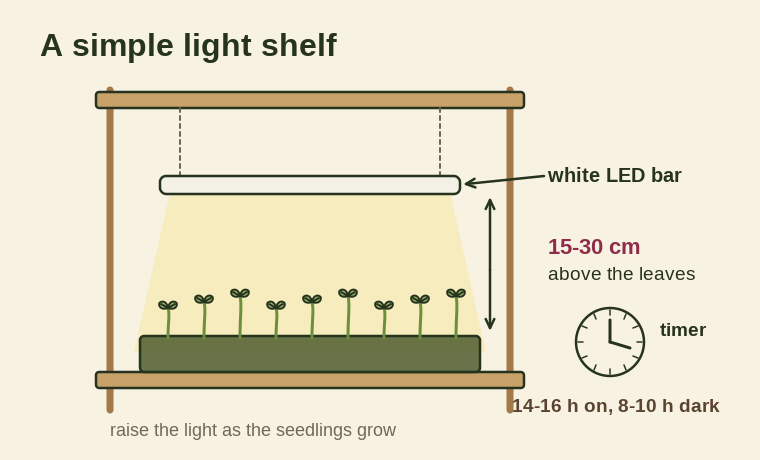
- Typical LED bars and panels: about 15 to 30 cm above the leaves. Stronger fixtures go higher; check the instructions.
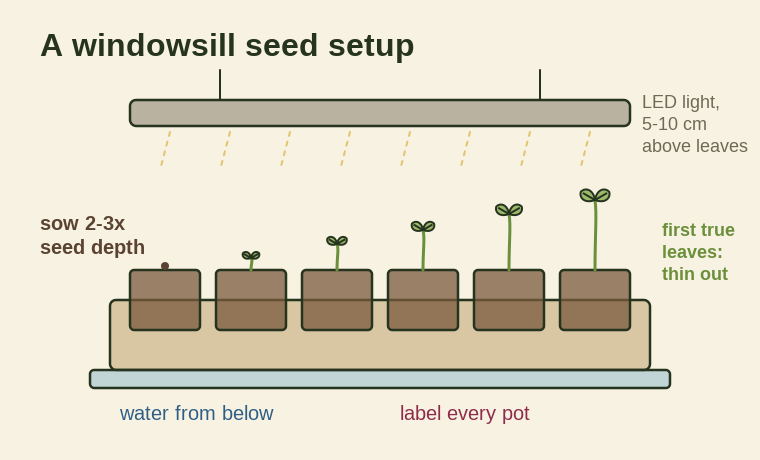
- Fluorescent tubes: much closer, about 5 to 10 cm.
Hang the light on chains or adjustable cords so you can raise it as plants grow. Then watch:
- Seedlings stretching: move the light closer or run it longer.
- Leaves bleached, pale yellow on top or crisp at the edges: move it higher.
- Short, sturdy, deep green growth: leave it where it is.
How many hours a day
Plants need both light and darkness. Use a plug-in timer so you don't have to remember.
- Seedlings: 14 to 16 hours on, 8 to 10 off.
- Microgreens: 12 to 16 hours.
- Herbs like basil, parsley and mint: 12 to 16 hours.
- Houseplants: usually 10 to 12 hours of extra light is plenty.
Running lights 24 hours a day does not help and can damage some plants. Tomatoes in particular can develop yellow, mottled leaves under constant light.
What a grow light costs to run
The calculation is simple: watts times hours, divided by 1,000, gives kilowatt-hours (kWh). Multiply by your electricity price.
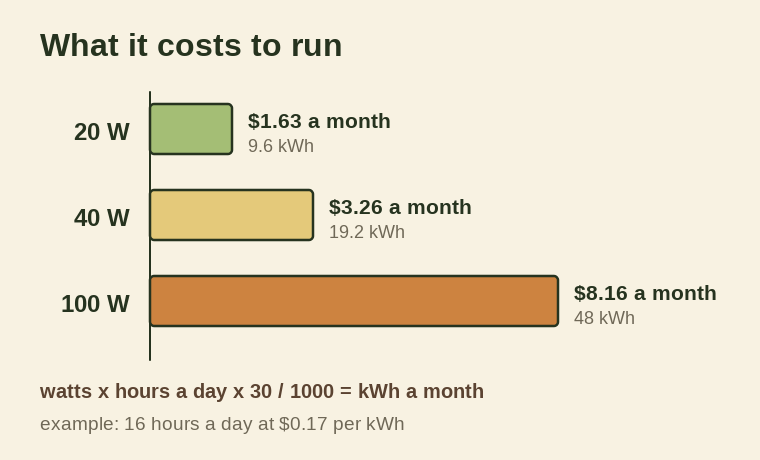
At an example price of $0.17 per kWh, running 16 hours a day for 30 days:
- 20 W light: 9.6 kWh, about $1.63 a month.
- 40 W light: 19.2 kWh, about $3.26 a month.
- 100 W light: 48 kWh, about $8.16 a month.
Your price may be higher or lower, so swap in the figure from your bill. For seed starting, the light usually runs for only 6 to 10 weeks a year. Our guide to saving energy at home has more ways to keep electricity costs down.
Setting up a simple light shelf
- Use a sturdy shelf near a socket, away from where water could splash electrics.
- Hang one LED bar per shelf, about as long as your seed trays.
- Line the back and sides with white card or matte white board to bounce light back to the plants.
- Plug lights into a timer and the timer into a socket with a residual current device (RCD/GFCI) if possible.
- Water carefully and keep cables and plugs away from trays.
For a full seed-starting schedule, see how to start seeds indoors. Under lights, microgreens on a windowsill become a year-round crop, and the same shelf can keep kitchen herbs going through winter.
Common questions
Can I use an ordinary LED household bulb? For a single herb pot, a bright white LED bulb placed close helps a little. Purpose-built fixtures spread light more evenly and are far more effective for trays.
Do grow lights get hot? LEDs run warm but not hot. If a fixture is too hot to touch, it is too close to the leaves.
Should I move seedlings outside gradually? Yes. Plants raised under lights must be hardened off over 7 to 10 days, starting in shade, because sunlight is far stronger.
Is the light bad for my eyes? Avoid staring into bright LEDs, especially purple ones. White light is more comfortable in living spaces.
A modest LED, the right height and a timer turn any shelf into a reliable nursery. Start small, watch how your plants respond and adjust from there.
Keep reading
-
 Small-Space Gardening
How to Grow Microgreens on a Windowsill in 7 to 14 Days
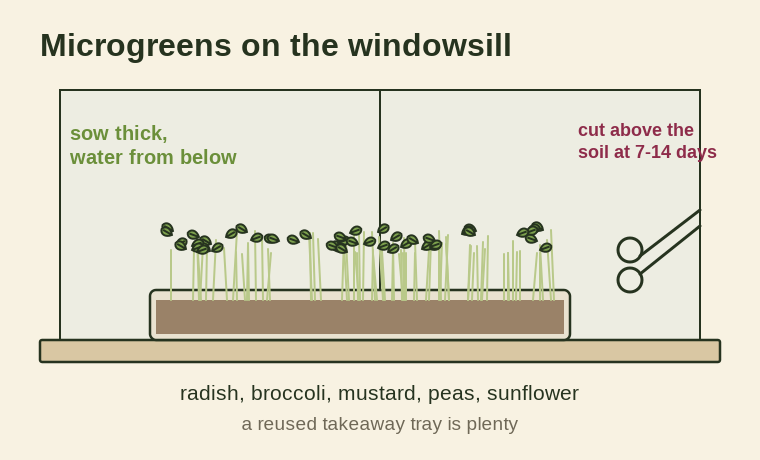
The easiest crop for an apartment. Which seeds to use, a tray setup from reused containers, daily care, harvesting and how to avoid mold.
-
 Small-Space Gardening
How to Grow a Balcony Herb Garden That Lasts All Year
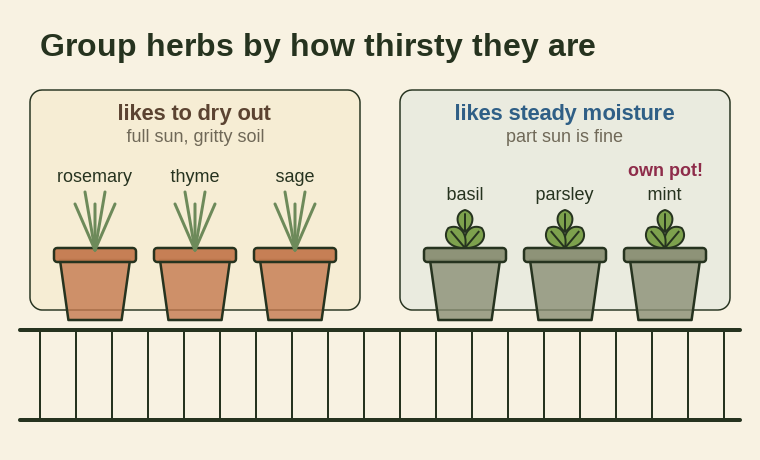
Which herbs suit sun, shade and wind, how to group them by water needs, and how to harvest so plants keep producing instead of fading.
-
 Growing Food
How to Start Seeds Indoors: From Tray to Transplant
Containers, seed-starting mix, light, water and timing. A step-by-step guide to raising strong vegetable seedlings on a windowsill or under a lamp.
More in Small-Space Gardening
- Growing Peppers and Chillies in Pots: Warmth, Feeding and Overwintering
- DIY Potting Mix: Simple Peat-Free Recipes for Pots, Seeds and Herbs
- How to Grow Strawberries in Pots, Baskets and Window Boxes
- How to Grow Potatoes in Bags, Buckets and Containers
- How to Grow Microgreens on a Windowsill in 7 to 14 Days
- Build a Vertical Garden From Recycled Materials: Pallets, Bottles and Gutters
- How to Grow a Balcony Herb Garden That Lasts All Year
- Growing Vegetables in Containers: Pot Sizes, Soil Mix and Watering