
Growing Lettuce and Salad Greens: Fresh Leaves for Most of the Year
How to grow lettuce and other salad greens from seed, with the main lettuce types, sowing depth, cut-and-come-again harvesting, bolting and succession sowing.
On this page
Lettuce is one of the fastest and most rewarding crops for a new grower. Baby leaves can be ready about four weeks after sowing, plants grow happily in beds, pots and window boxes, and a few square meters can keep a household in salad for months. Homegrown leaves also skip the plastic clamshells and the short fridge life of bagged salad.
The main challenge is not growing lettuce but keeping a steady supply: sowing too much at once leads to a glut followed by nothing. This guide covers the types worth growing, how to sow, how to harvest so plants keep producing, and how to avoid bolting.
Lettuce types and other salad greens
| Type | Shape and texture | Time to harvest | Good to know |
|---|---|---|---|
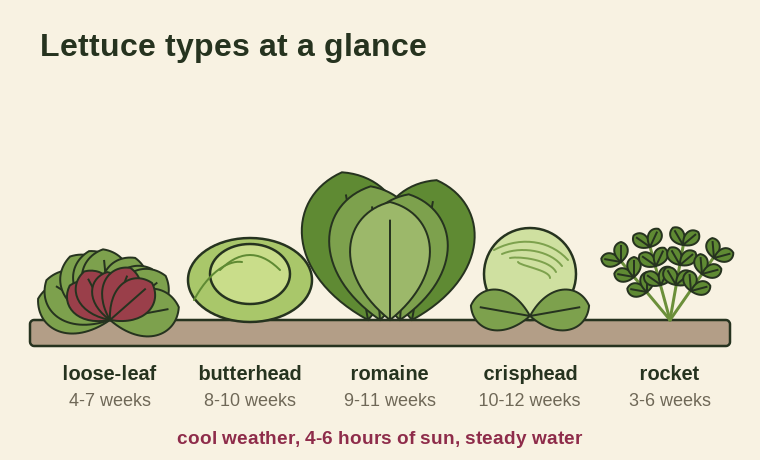
| Loose-leaf | Open rosette, no heart | 4 weeks (baby) to 7 weeks | Best for cut-and-come-again |
| Butterhead | Soft, loose head | 8 to 10 weeks | Tender; some types tolerate cool weather |
| Romaine (cos) | Upright, crisp, long leaves | 9 to 11 weeks | Fairly slow to bolt |
| Crisphead (iceberg) | Tight, crunchy head | 10 to 12 weeks | Fussiest; needs steady cool weather and water |
| Rocket (arugula) | Peppery lobed leaves | 3 to 6 weeks | Bolts fast in heat; great in spring and autumn |
| Mizuna and mustards | Frilly, mild to spicy | 3 to 6 weeks | Very cold-hardy |
| Spinach | Smooth dark leaves | 5 to 7 weeks | Bolts in long days; best in spring and autumn |
| Corn salad (lamb's lettuce) | Small rosettes | 8 to 10 weeks | Hardy winter salad |
For a first try, a packet of loose-leaf lettuce or a "salad mix" of several types gives the quickest and most reliable results. Lettuce also appears in our list of the easiest vegetables for beginners.
When and where to sow
Lettuce is a cool-season crop. It grows best at about 10 to 20 °C and germinates well in soil around 15 to 20 °C. Above roughly 25 °C, many varieties refuse to germinate at all, a natural dormancy that protects seedlings from summer heat.
- Spring: start sowing a few weeks before your last frost; young lettuce tolerates light frost.
- Summer: sow in the evening, in a shady spot, or start seeds indoors where it is cooler. Choose slow-bolting varieties.
- Autumn and winter: sow hardy types such as corn salad, mizuna and winter lettuces, under a cloche or cold frame in colder areas.
Lettuce needs less sun than fruiting crops. Four to six hours of direct light is enough, and afternoon shade helps in hot weather.
How to sow
- Prepare fine, moist soil with some compost worked in. Lettuce has shallow roots, so the top 15 cm matters most.
- Sow shallowly. Many lettuce seeds need light to germinate, so cover them with only a sprinkle of soil, about 0.5 cm.
- Water gently with a fine rose so the seeds are not washed away, and keep the surface moist until they sprout, usually in 5 to 10 days.
- Thin seedlings once they have a few true leaves: about 15 to 20 cm apart for loose-leaf types and 25 to 30 cm for heading types. Eat the thinnings.
- For baby leaves, sow thickly in a band and skip thinning; you will harvest the whole patch young.
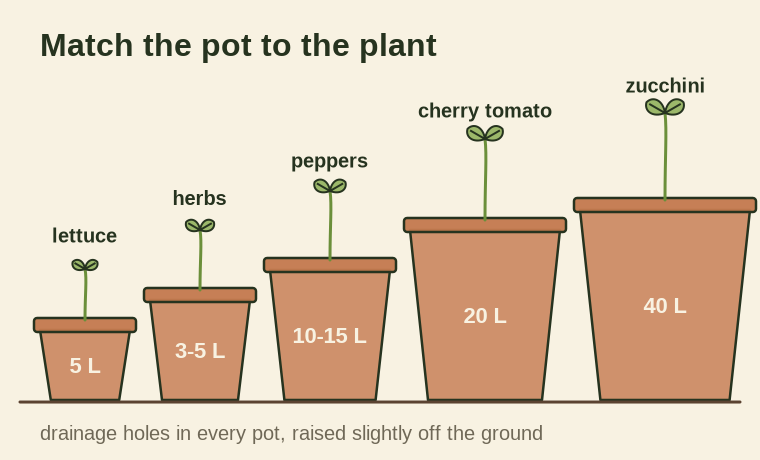
In containers, any pot at least 15 cm deep works. A good homemade potting mix and regular watering are all lettuce needs. See our guide to growing vegetables in containers for pot choices.
Cut-and-come-again harvesting
Loose-leaf lettuces and most salad greens regrow after cutting, giving several harvests from one sowing.
- Cut the whole plant about 2 to 3 cm above the soil when the leaves are 8 to 10 cm tall. Leave the growing point intact and it will resprout in two to three weeks. Most plants give two or three cuts before they tire.
- Or pick outer leaves, taking a few from each plant and leaving the center to keep growing. This keeps plants going for longer.
Harvest in the morning, when leaves are crisp, and rinse and chill them straight away.
Bolting: why lettuce turns bitter
Bolting is when the plant stops making leaves and sends up a tall flower stem. It is triggered mainly by long days and heat, and stress from dry soil makes it worse. The signs are an elongating central stem, leaves that taste bitter, and a milky sap.
To delay it:
- Sow slow-bolting varieties for summer crops.
- Keep the soil evenly moist, and mulch to keep roots cool.
- Give plants afternoon shade during hot spells.
- Harvest regularly and sow again rather than keeping old plants going.
Once a plant bolts, there is no reversing it. Pull it for the compost, or let a few flower if you want to try saving your own seed, which is easy with lettuce because it mostly self-pollinates.
Succession sowing for a steady supply
The trick to constant salad is to sow a little, often. Every two to three weeks, sow a short row or a single pot. When one batch is being cut, the next is growing, and a third is just germinating.
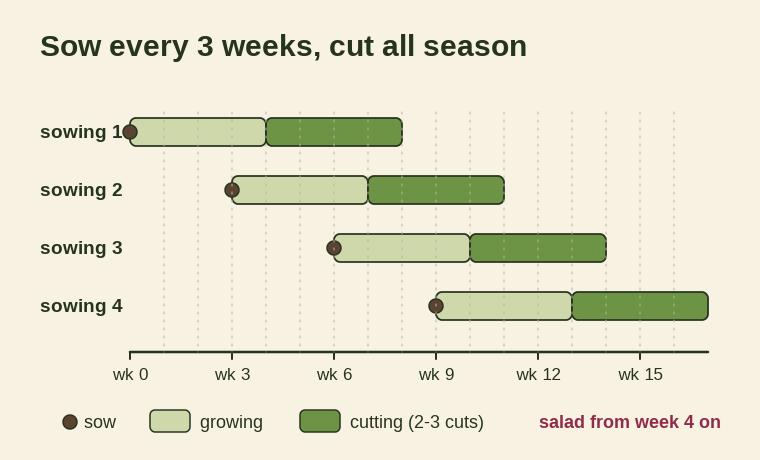
As a rough guide, a 1 m row sown every three weeks gives a small household salad two or three times a week. Adjust the size of each sowing rather than the timing.
Common questions
Why did my lettuce seeds not come up? The most common causes are soil that is too warm, seed sown too deep, or the surface drying out. Try sowing in a cooler spot, barely covered, and keep it moist.
Can I grow lettuce indoors? Yes, on a bright windowsill or under a grow light, especially as baby leaves. Growing microgreens on a windowsill is an even quicker way to get fresh greens in winter.
Why are the leaves tough and bitter? Usually heat, lack of water or old plants. Harvest younger and keep the soil moist.
With a packet of mixed seed, a sunny-to-part-shade spot and a habit of sowing every few weeks, you can cut fresh salad from spring until the first hard frosts, and longer with a little cover.
Keep reading
-
 Small-Space Gardening
How to Grow Microgreens on a Windowsill in 7 to 14 Days
The easiest crop for an apartment. Which seeds to use, a tray setup from reused containers, daily care, harvesting and how to avoid mold.
-
 Growing Food
10 Easiest Vegetables to Grow for Beginners (and How Not to Kill Them)
Ten forgiving crops for a first vegetable garden, with spacing, time to harvest and the one mistake to avoid for each.
-
 Small-Space Gardening
Growing Vegetables in Containers: Pot Sizes, Soil Mix and Watering
How big each pot should be, how to mix a potting soil that doesn't compact, and a watering routine that keeps container crops healthy.
More in Growing Food
- How to Grow Tomatoes: A Beginner's Guide From Seed to Harvest
- Companion Planting: What Works, What's Folklore, and Easy Pairs to Try
- Regrow Vegetables From Kitchen Scraps: What Works and What's Just a Nice Idea
- How to Save Seeds From Your Garden: Tomatoes, Beans, Peppers and More
- 10 Easiest Vegetables to Grow for Beginners (and How Not to Kill Them)
- How to Start Seeds Indoors: From Tray to Transplant
- Crop Rotation for Small Gardens: A Simple 4-Bed Plan That Works
- Raised Bed Gardening for Beginners: Size, Materials and Filling